
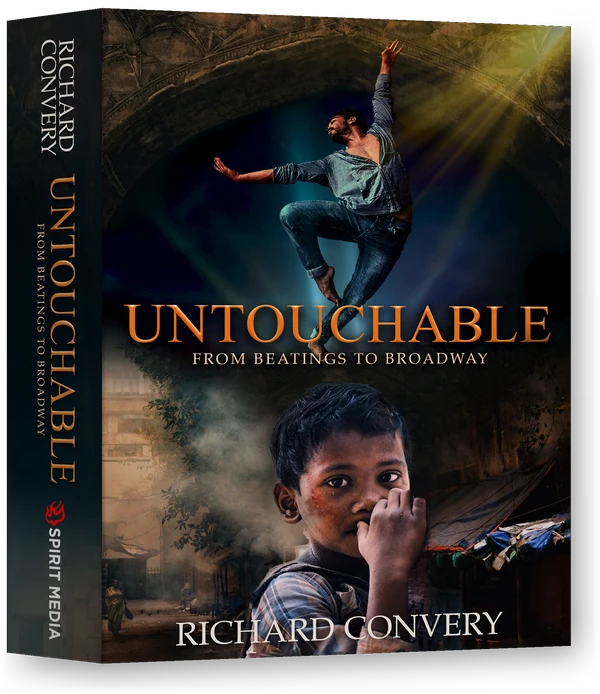
By Richard Convery · Foreword by Elisha, founder of Son-Shine
Untouchable
From Beatings To Broadway
For readers who want to understand the human cost of caste in India, readers who love stories of faith, rescue and hope against all odds, and readers of Christian and world fiction drawn to novels set in India.
A work of fiction inspired by real events: a five-year-old Dalit orphan in rural India flees a violent father and searches for survival while a young man builds a refuge for children no one else will take.
15% off first order + free standard shipping to 223 countries
Afghanistan, Åland Islands, Albania, Algeria, Andorra, Angola, Anguilla, Antigua And Barbuda, Argentina, Armenia, Aruba, Australia, Austria, Azerbaijan, Bahamas, Bahrain, Bangladesh, Barbados, Belgium, Belize, Benin, Bermuda, Bhutan, Bolivia, Bosnia And Herzegowina, Botswana, Brazil, Brunei Darussalam, Bulgaria, Burkina Faso, Burundi, Cambodia, Cameroon, Canada, Cape Verde, Caribbean Netherlands, Cayman Islands, Central African Republic, Chad, Chile, China, Colombia, Comoros, Cook Islands, Costa Rica, Cote D'ivoire, Croatia (Local Name: Hrvatska), Curaçao, Cyprus, Czech Republic, Denmark, Djibouti, Dominica, Dominican Republic, Ecuador, Egypt, El Salvador, Equatorial Guinea, Eritrea, Estonia, Ethiopia, Falkland Islands (Malvinas), Faroe Islands, Fiji, Finland, France, French Guiana, French Polynesia, Gabon, Gambia, Georgia, Germany, Ghana, Gibraltar, Greece, Greenland, Grenada, Guadeloupe, Guam, Guatemala, Guernsey, Guinea, Guinea-Bissau, Guyana, Haiti, Holy See (Vatican City State), Honduras, Hong Kong, Hungary, Iceland, India, Indonesia, Iraq, Ireland, Isle of Man, Israel, Italy, Jamaica, Japan, Jersey, Jordan, Kazakhstan, Kenya, Kiribati, Kuwait, Kyrgyzstan, Lao People's Democratic Republic, Latvia, Lebanon, Lesotho, Liberia, Libyan Arab Jamahiriya, Liechtenstein, Lithuania, Luxembourg, Macao, Macedonia, The Former Yugoslav Republic Of, Madagascar, Malawi, Malaysia, Maldives, Mali, Malta, Martinique, Mauritania, Mauritius, Mayotte, Mexico, Moldova, Republic Of, Monaco, Mongolia, Montenegro, Montserrat, Morocco, Mozambique, Myanmar, Namibia, Nauru, Nepal, Netherlands, New Caledonia, New Zealand, Nicaragua, Niger, Nigeria, Niue, Norway, Oman, Pakistan, Palestinian Territory, Occupied, Panama, Papua New Guinea, Paraguay, Peru, Philippines, Pitcairn, Poland, Portugal, Puerto Rico, Qatar, Republic of Korea, Reunion, Romania, Rwanda, Saint Barthélemy, Saint Kitts And Nevis, Saint Lucia, Saint Martin, Saint Vincent And The Grenadines, Samoa, San Marino, Sao Tome And Principe, Saudi Arabia, Senegal, Serbia, Seychelles, Sierra Leone, Singapore, Sint Maarten, Slovakia (Slovak Republic), Slovenia, Solomon Islands, Somalia, South Africa, Spain, Sri Lanka, St. Helena, St. Pierre And Miquelon, Sudan, Suriname, Svalbard And Jan Mayen Islands, Swaziland, Sweden, Switzerland, Taiwan, Tajikistan, Tanzania, United Republic Of, Thailand, Timor-Leste, Togo, Tokelau, Tonga, Trinidad And Tobago, Tunisia, Turkey, Turkmenistan, Turks And Caicos Islands, Tuvalu, Uganda, Ukraine, United Arab Emirates, United Kingdom, United States, Uruguay, Uzbekistan, Vanuatu, Viet Nam, Virgin Islands (British), Wallis And Futuna Islands, Western Sahara, Yemen, Zambia, Zimbabwe
At five years old, Naggya had already learned to run. This is the story of what he ran toward.
At five, Naggya had already learned to run, to run fast.
A novel inspired by real events, set among the Dalits of India, the people at the bottom of the traditional caste hierarchy. Richard Convery follows a five-year-old orphan in rural Andhra Pradesh and a young man who builds a refuge and school for children no one else will take, in a story of cruelty and discrimination and of compassion that reaches one child at a time. A note on subjects: the novel is about poverty, discrimination and violence against children and their families, including the loss of a parent and a child left alone. These scenes are part of the story the author set out to tell and are written without being the whole of the book, which is also about rescue, school, friendship and hope. It is a work of fiction for adult readers and is not a history or a guide to caste.
What makes this book for readers who want to see the human cost of caste
A 478-page work of fiction that the author describes as "lifted directly from the life-and-death experiences" of the founder of Son-Shine, an orphanage and school in India that has rescued, housed and educated many thousands of Dalit children since 2006.
Five things set it apart:
- It is told through a child. The story opens when Naggya is five, running with his mother toward the jungle, and follows him from fear and survival to school, friendship and a future he could not have imagined.
- It is rooted in a real refuge. A foreword by the founder of Son-Shine calls the book "a window into the world of our Dalit children and people's lives."
- It shows how a rescue begins. A young man who once preached revolutionary philosophies at university meets a homeless six-year-old and begins a refuge in his parents' mud house with one child.
- It is faith-based. The refuge at the heart of the book is a Christian ministry, and the novel is shelved with Christian and world fiction, though it is a novel and not a devotional.
- It has a surprising arc. The title says From Beatings To Broadway, and the book has ballet and New York theater scenes, which are left unspoiled here.
About the author
Written by
Richard Convery
Published by
 Spirit Media Publishing

Richard Convery
Richard Convery is an Australian author whose novel Untouchable: From Beatings To Broadway is a work of fiction inspired by real events. In 2009 he first met the founder of Son-Shine, an orphanage and school in India that has rescued, housed and educated many thousands of Dalit children since 2006, and he relied on him for insight into the lives of India's Dalits while researching the book.
Spirit Media Publishing
Spirit Media Publishing is a Christian publishing and marketing company with a vision to reveal our Father's heart to all nations. It offers full-service book creation and publishing in paperback, hardback, digital and audiobook formats, along with children's titles, compact Express Books, website design and SEO, and podcast and video production. We are glad to publish a novel that opens a window on the lives of India's Dalit children.
What's inside
- A note from the author on why the founder of Son-Shine wrote the foreword, and the foreword itself
- A page that defines Dalit and the traditional caste categories before the story begins
- A title page that marks the novel as inspired by real events
- A single long story told in short chapters, following Naggya from rural Andhra Pradesh toward school, friendship, ballet and the stage
- A second thread about a young man who walks away from his university philosophies and starts a refuge and school for children without parents
- Paperback and hardback, with eBook and audiobook editions; the paperback is 478 pages
Product details
- Title
- Untouchable
- Paperback ISBN
- 978-1-958304-35-8
- Hardback ISBN
- 978-1-958304-81-5
- eBook ISBN
- 978-1-958304-37-2
- Audiobook ISBN
- 978-1-958304-38-9
- Subtitle
- From Beatings To Broadway
- Author
- Richard Convery
- Publisher
- Spirit Media Publishing
- Language
- English
- Pages
- 478 (paperback)
- Trim size
- 5 x 7 inches
- Binding
- Paperback (perfect bound, matte laminate) and hardback, black and white interior on cream paper
- Library of Congress Control Number
- 2023902676
For readers who want to understand the human cost of caste
This is a novel, not a textbook, but it opens a window. The founder of Son-Shine, who wrote the foreword, asks you not to read it "as you would read another book, but to read it as you would a life." If you want the weight of discrimination and poverty explained through one child's days rather than statistics, this is where the story begins.
For readers who love stories of faith, rescue and hope against all odds
The book follows a refuge that grew from "the humblest of beginnings," a veranda against a mud house, to a school with caregivers, a cook and a permanent water supply. Along the way it shows opposition, shortage and fear. If you are drawn to true-to-life stories of compassion that keeps going when the odds say stop, this is one.
For readers of Christian and world fiction set in India
If you enjoy novels that take you somewhere you have never been, here is rural Andhra Pradesh, a village's edge, a mud house and an orphanage. The book is classed with Christian and world fiction and is written for adults.
For readers who love a coming-of-age story
Naggya is five when the book begins and a teenager when his mentor first shows him ballet on a screen. In between are hunger, fear, an aunt who does not know how to raise him, school and friendship. If you like to watch a child grow up on the page, from running for his life to wondering how dancers can be so strong, the novel gives you the whole arc, and the title tells you where it is heading.
Three moments from the book
The run
Chapter One opens on a dawn chase. Naggya, who is five, urges his mother to run faster toward the jungle where his father, a drinker, will not find them. What follows costs him his mother, and the next pages follow a child alone: three days and three lonely nights of wandering, a search for water, and an effort to find his aunt, the only relative he has ever met. When he is most afraid, "he silently repeated his mother's words: 'Son, you must be strong!'"
A homeless six-year-old
In a chapter about the young man who will found the refuge, a university student who spent his days "spruiking the philosophies of Lenin or Marx or Mao" comes home for a visit and meets a homeless six-year-old. One thought changes him: "if my parents had died like so many others, this boy could so easily be me." The next lines say that "An indescribable glow filled Elijah," and that he returned home determined "to start a revolution, not to the masses, but merely to one." The refuge begins in his parents' two-room house.
Ballet
Years later, Naggya is a teenager when his mentor shows him something on a screen: ballet. He watches the grace and strength of the dancers in amazement, and then asks, "But how, how do they do that? It looks so, they must be so strong!" It is a lighter scene, and it opens a door that leads to the other half of the book's title.
Why this book exists
The author met the founder of Son-Shine in 2009. In the thirteen years since, he writes, he has "relied countless times" on him "for insight and understanding," as "a westerner from Australia" trying to shed light on the lives of Dalits. He is clear about what kind of book this is: "Although Untouchable is a work of fiction, much of the content of this novel has been lifted directly from the life-and-death experiences" of the founder's world.
The founder, in his own foreword, writes of why he welcomes it: "Through this book, may your eyes be open to see the other side of the world of the Untouchable Dalits." He adds, "May God speak to you through this book."
Questions
What is Untouchable about?
A novel inspired by real events: Naggya, a five-year-old Dalit orphan in rural India, flees a violent father and searches for survival while a young man builds a refuge and school for Dalit children.
Is it a true story?
It is a work of fiction inspired by real events, much of it drawn from the life-and-death experiences of the founder of Son-Shine, who wrote one of the book's forewords.
Does it explain the caste system?
It opens a window on India's Dalits, the people at the bottom of the traditional caste hierarchy, through a story, and the first pages define the traditional categories. It is a novel, not a history or a guide to caste.
What does the title mean?
The book's own definition says that those at the bottom of the traditional hierarchy are "considered 'untouchables' or Dalits." The title names the people the story is about.
Is it a Christian book?
It follows a faith-based refuge and is shelved with Christian and world fiction, but it is a novel and not labeled devotional.
What does Broadway have to do with it?
The subtitle From Beatings To Broadway reflects the boy's arc. The book includes ballet and New York theater scenes, and the path from one to the other is left unspoiled here.
Does it deal with social injustice?
Yes. Discrimination, poverty and unequal treatment of Dalit families run through the story, and so does the response of a young man who decides to take in one child at a time.
Is it suitable for every reader?
It is written for adults and includes violence against a child and a parent's death. If these themes are difficult for you, read the note on subjects above first.