
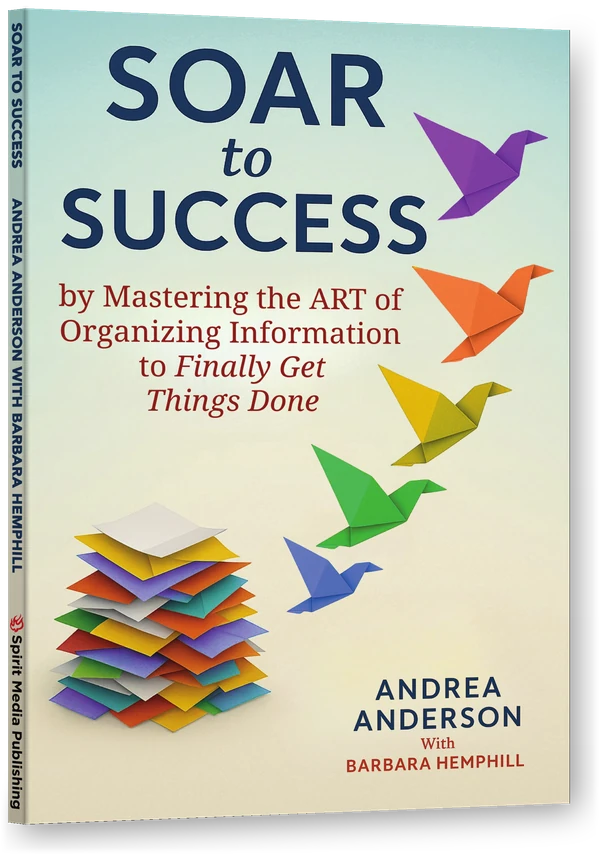
By Andrea Anderson with Barbara Hemphill · Foreword by Barbara Hemphill
SOAR To Success
Mastering the ART of Organizing Information to Finally Get Things Done
For professionals, business owners and retirees buried in paper, email and digital files, and for anyone who has tried organizing systems that did not last.
Andrea Anderson and Barbara Hemphill share the Productive Environment Finding SYSTEM, a keyword-driven File Index that works like Google for your filing cabinet, in ten short chapters with client snapshots.
15% off first order + free standard shipping to 223 countries
Afghanistan, Åland Islands, Albania, Algeria, Andorra, Angola, Anguilla, Antigua And Barbuda, Argentina, Armenia, Aruba, Australia, Austria, Azerbaijan, Bahamas, Bahrain, Bangladesh, Barbados, Belgium, Belize, Benin, Bermuda, Bhutan, Bolivia, Bosnia And Herzegowina, Botswana, Brazil, Brunei Darussalam, Bulgaria, Burkina Faso, Burundi, Cambodia, Cameroon, Canada, Cape Verde, Caribbean Netherlands, Cayman Islands, Central African Republic, Chad, Chile, China, Colombia, Comoros, Cook Islands, Costa Rica, Cote D'ivoire, Croatia (Local Name: Hrvatska), Curaçao, Cyprus, Czech Republic, Denmark, Djibouti, Dominica, Dominican Republic, Ecuador, Egypt, El Salvador, Equatorial Guinea, Eritrea, Estonia, Ethiopia, Falkland Islands (Malvinas), Faroe Islands, Fiji, Finland, France, French Guiana, French Polynesia, Gabon, Gambia, Georgia, Germany, Ghana, Gibraltar, Greece, Greenland, Grenada, Guadeloupe, Guam, Guatemala, Guernsey, Guinea, Guinea-Bissau, Guyana, Haiti, Holy See (Vatican City State), Honduras, Hong Kong, Hungary, Iceland, India, Indonesia, Iraq, Ireland, Isle of Man, Israel, Italy, Jamaica, Japan, Jersey, Jordan, Kazakhstan, Kenya, Kiribati, Kuwait, Kyrgyzstan, Lao People's Democratic Republic, Latvia, Lebanon, Lesotho, Liberia, Libyan Arab Jamahiriya, Liechtenstein, Lithuania, Luxembourg, Macao, Macedonia, The Former Yugoslav Republic Of, Madagascar, Malawi, Malaysia, Maldives, Mali, Malta, Martinique, Mauritania, Mauritius, Mayotte, Mexico, Moldova, Republic Of, Monaco, Mongolia, Montenegro, Montserrat, Morocco, Mozambique, Myanmar, Namibia, Nauru, Nepal, Netherlands, New Caledonia, New Zealand, Nicaragua, Niger, Nigeria, Niue, Norway, Oman, Pakistan, Palestinian Territory, Occupied, Panama, Papua New Guinea, Paraguay, Peru, Philippines, Pitcairn, Poland, Portugal, Puerto Rico, Qatar, Republic of Korea, Reunion, Romania, Rwanda, Saint Barthélemy, Saint Kitts And Nevis, Saint Lucia, Saint Martin, Saint Vincent And The Grenadines, Samoa, San Marino, Sao Tome And Principe, Saudi Arabia, Senegal, Serbia, Seychelles, Sierra Leone, Singapore, Sint Maarten, Slovakia (Slovak Republic), Slovenia, Solomon Islands, Somalia, South Africa, Spain, Sri Lanka, St. Helena, St. Pierre And Miquelon, Sudan, Suriname, Svalbard And Jan Mayen Islands, Swaziland, Sweden, Switzerland, Taiwan, Tajikistan, Tanzania, United Republic Of, Thailand, Timor-Leste, Togo, Tokelau, Tonga, Trinidad And Tobago, Tunisia, Turkey, Turkmenistan, Turks And Caicos Islands, Tuvalu, Uganda, Ukraine, United Arab Emirates, United Kingdom, United States, Uruguay, Uzbekistan, Vanuatu, Viet Nam, Virgin Islands (British), Wallis And Futuna Islands, Western Sahara, Yemen, Zambia, Zimbabwe
Find anything you file in seconds, on paper or on your computer.
Clutter is postponed decisions.
For professionals, business owners and retirees whose desks hold piles of paper, whose inboxes are overflowing and whose hard drives look like a digital junk drawer, and who have tried systems that did not last. Andrea Anderson, CEO of the Productive Environment Institute, writes with Barbara Hemphill, author of Taming the Paper Tiger, in ten short chapters built around a keyword-driven File Index that works like Google for your filing cabinet.
What makes this book for people who want a filing system that lasts
Most organizing advice tells you where to put things. This book is about finding them again. The authors put it plainly: “most people don't mind filing, they mind not being able to find what they filed.” The answer they teach is a numbered, keyword-indexed filing system that anyone, even a family member or team assistant, can use to retrieve a paper in moments.
Five things set it apart:
- It was born from a real frustration. Andrea Anderson was organizing a boss's office, and each time the work looked neat but nothing could be found. She typed “filing system” into Google, and the first result was Barbara Hemphill.
- It is keyword-driven. You label a folder with a number, then record keywords in one File Index, so a search for a word such as Honda or mechanic tells you which numbered folder holds the papers.
- It covers paper and digital in one way of thinking. Paper gets numbers, because “the drawers don't have search bars.” Digital files get a simple alphabetical folder structure, because search is built in.
- It runs on one decision tool. Every item is an Action, a Reference or a Toss, a method the book calls the ART of Organizing Information.
- It is honest about time. The introduction says “Will this work overnight? No.” and promises change through intention and practice.
About the author
Written by
Andrea Anderson with Barbara Hemphill
Foreword by
Barbara Hemphill
Published by
 Spirit Media Publishing

Andrea Anderson with Barbara Hemphill
Andrea Anderson is CEO of the Productive Environment Institute. She began her career as a teacher, and her experience in education and mental health gave her deep compassion for people who feel overwhelmed. While working for a family preservation agency in 2005 she discovered Barbara Hemphill's numerical filing system, and within a year she joined Barbara's team, left her job and launched her own organizing business. Barbara Hemphill is the author of Taming the Paper Tiger and the founder of the Productive Environment Institute, and she wrote the Foreword to this book.
Spirit Media Publishing
Spirit Media Publishing is a Christian publishing and marketing company with a vision to reveal our Father's heart to all nations. It offers full-service book creation and publishing in paperback, hardback, digital and audiobook formats, along with children's titles, compact Express Books, website design and SEO, and podcast and video production. We are honored to publish this guide to finding what you file.
What's inside
- A Foreword by Barbara Hemphill and an Introduction by Andrea Anderson
- Reader testimonials near the front, including a professional organizer of more than forty years who says the system gives you “back your peace of mind”
- The File Index, explained for physical files and for digital files
- The Magic 7, the seven tools to put in place before you organize anything
- The ART of Organizing Paper, Email and Digital Information
- Three ways to organize Action items: by date, by type and by project
- Client snapshots in most chapters, each a short story with a quoted result
- A closing chapter on keeping the system going, with a workshop named as the next step
- A paperback of 88 pages, 6 x 9 inches, also published as an eBook and a PDF edition
Product details
- Title
- SOAR To Success
- Paperback ISBN
- 979-8-89307-207-5
- eBook ISBN
- 979-8-89307-209-9
- Subtitle
- Mastering the ART of Organizing Information to Finally Get Things Done
- Author
- Andrea Anderson with Barbara Hemphill
- Foreword
- Barbara Hemphill
- Publisher
- Spirit Media Publishing
- Language
- English
- Pages
- 88 (paperback)
- Trim size
- 6 x 9 inches
- Binding
- Paperback, perfect bound
- Library of Congress Control Number
- 2026900275
For people buried in paper
Chapter 3 starts the clearing with a First Sort: make three piles, pick up one item at a time, and ask what it requires from you. The book says clients often find that “50% or more of their piles go straight to Toss, they just never stopped to decide.” A bill you have not paid is an Action, a child's report card is a Reference, and an expired flyer is a Toss.
For anyone whose inbox is overflowing
Chapter 6 applies the same three choices to email, and it takes a firm line on one popular habit: “We no longer recommend the popular 2-minute rule,” because it can fill a session with minor tasks and leave your most important work untouched. The chapter's advice for old mail is gentle: “Today's Mail is tomorrow's pile.” You do not have to clean up the past, only start organizing for the future.
For people who have tried systems that did not last
The authors list what helps a system last: “A system you trust,” “A simple rhythm” and “Support when you drift.” The last chapter says a sustainable system “doesn't prevent that” change in life and priorities. It “supports you through it.”
For retirees and caregivers managing family affairs
The Introduction speaks to readers who are retired but managing their own affairs and, increasingly, the affairs of an aging parent. The File Index is described as useful for more than paper: it works for storage, memorabilia, binders and client papers too.
Three moments from the book
A boss who could not find anything
In the Introduction, Andrea Anderson was working for a family preservation agency and spending days, even weeks, putting a busy boss's papers in order. Everything looked neat when she left. The boss would return from a trip and say “it looks great, but I can't find anything.” After one more failed attempt she sat at the desk in tears and prayed, “God, there has got to be a better way!” Moments later she typed “filing system” into Google. The first result was Barbara Hemphill, and Barbara's numerical finding system, supported by a simple index, gave “every piece of paper” a clear place to go and “a reliable way to find it again.”
Car, Honda or Vehicle?
Chapter 1 tells how the File Index began. In 1978 Barbara Hemphill was using alphabetical folders, and they worked “until it didn't.” One person labeled a file Car while the spouse looked under Honda or Vehicle. She began writing file names on a yellow legal pad so others could see what existed, and that became her first File Index. The book compares it this way: “A File Index is to filing what a Chart of Accounts is to accounting.”
Six drawers from two homes
A retired educator came to the authors with six drawers of paper from two homes and no clear system. Once her Reference files had numbers and keywords such as insurance, Blue Cross and auto policy, she said “I've had these files for 20 years and could never find what I needed. Now I can find it in seconds.” She printed her File Index for the front of the drawer and kept a digital copy that is searchable on her phone.
Why this book exists
Andrea Anderson says the book exists “to offer you a way forward. To honor Barbara's legacy.” She wants the reader to feel hopeful: “You can accomplish your work and enjoy your life.” The book is also an invitation into a community, because the authors believe “Together, We Are Better!”
Barbara Hemphill adds one thing she wants a reader to keep: “If you remember only one truth from this book, let it be this: Clutter is postponed decisions.”
Questions
What is SOAR To Success about?
It is a guide to the Productive Environment Finding SYSTEM, a keyword-driven filing system with a File Index for paper and digital files, written by Andrea Anderson with Barbara Hemphill in ten short chapters.
How does the filing system work?
Paper folders are labeled with numbers, such as Ref 1 and Ref 2, and each number is logged in a File Index with keywords. Searching the index for a word like Honda or mechanic shows which numbered folder holds the paper. For digital files the book recommends a simple alphabetical folder structure, because search is built in.
Is there a way to deal with a flooded email inbox?
Yes. Chapter 6 teaches the ART of Organizing Email, where every message is an Action, a Reference or a Toss. It suggests triaging email by priority, and it offers the line “Today's Mail is tomorrow's pile.” It does not promise inbox zero.
What does clutter is postponed decisions mean?
It is Barbara Hemphill's phrase, and the book repeats it in the Foreword and in Chapter 3: clutter is not caused by having too much information, it comes from decisions not yet made. The chapter on digital clutter applies it to unread mail and unsorted files too.
Does it help with digital clutter?
Yes. Chapter 6 says “Digital clutter creates decision fatigue, even if you don't see it.” It advises starting fresh today rather than refiling thousands of old files: rename what you download, move processed email to Action, Reference or Archive, and keep a simple alphabetical folder structure.
What is the Magic 7?
The seven tools the book says to have in place before you organize anything. They are, in order:
- In / Out / File Trays
- Toss / Recycle / Shred
- Calendar / Planner
- Contact Relationship Manager (CRM)
- Action System
- Reference System
- Integrated Task Manager, which the book names the SOAR Board
Is it a book about daily planning and time management?
Part of it is. Chapter 7 teaches planning your day, week and month, and it says the breakthrough “comes from learning how to spend the time you already have.” Its core, though, is the filing and decision system.
Does the book depend on buying something else?
The method is taught in the book, and the authors say you can use paper, a computer or both. The book also names its own digital tool, a CRM and a workshop that readers can choose for extra support.