
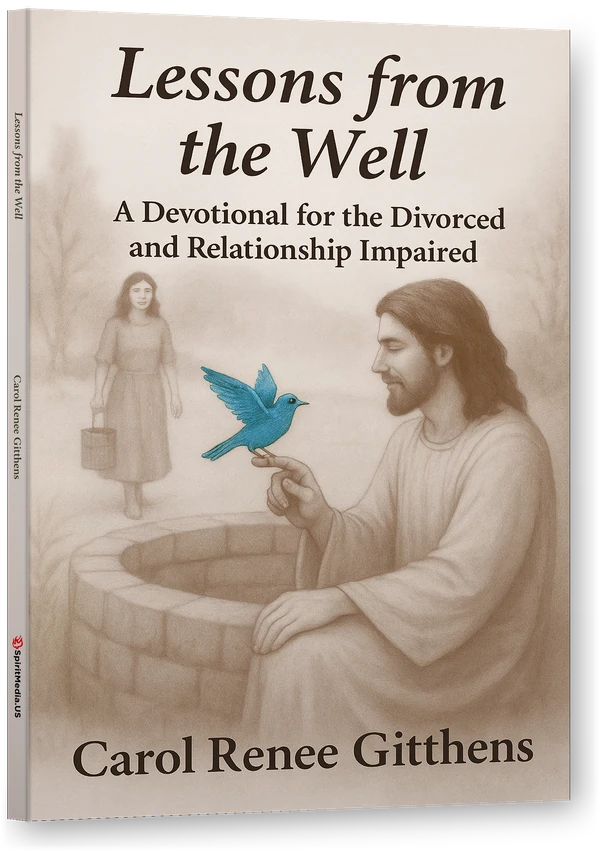
By Carol Renee Gitthens · Foreword by Stephanie Hensley
Lessons from the Well
A Devotional for the Divorced and Relationship Impaired
For Christian readers healing from divorce and broken relationships, anyone who has asked how a breakup changed their sense of worth, and groups that want to study it together.
A devotional for the divorced and relationship impaired, written by a pastor's daughter who found grace waiting on the other side: God will restore.
15% off first order + free standard shipping to 223 countries
Afghanistan, Åland Islands, Albania, Algeria, Andorra, Angola, Anguilla, Antigua And Barbuda, Argentina, Armenia, Aruba, Australia, Austria, Azerbaijan, Bahamas, Bahrain, Bangladesh, Barbados, Belgium, Belize, Benin, Bermuda, Bhutan, Bolivia, Bosnia And Herzegowina, Botswana, Brazil, Brunei Darussalam, Bulgaria, Burkina Faso, Burundi, Cambodia, Cameroon, Canada, Cape Verde, Caribbean Netherlands, Cayman Islands, Central African Republic, Chad, Chile, China, Colombia, Comoros, Cook Islands, Costa Rica, Cote D'ivoire, Croatia (Local Name: Hrvatska), Curaçao, Cyprus, Czech Republic, Denmark, Djibouti, Dominica, Dominican Republic, Ecuador, Egypt, El Salvador, Equatorial Guinea, Eritrea, Estonia, Ethiopia, Falkland Islands (Malvinas), Faroe Islands, Fiji, Finland, France, French Guiana, French Polynesia, Gabon, Gambia, Georgia, Germany, Ghana, Gibraltar, Greece, Greenland, Grenada, Guadeloupe, Guam, Guatemala, Guernsey, Guinea, Guinea-Bissau, Guyana, Haiti, Holy See (Vatican City State), Honduras, Hong Kong, Hungary, Iceland, India, Indonesia, Iraq, Ireland, Isle of Man, Israel, Italy, Jamaica, Japan, Jersey, Jordan, Kazakhstan, Kenya, Kiribati, Kuwait, Kyrgyzstan, Lao People's Democratic Republic, Latvia, Lebanon, Lesotho, Liberia, Libyan Arab Jamahiriya, Liechtenstein, Lithuania, Luxembourg, Macao, Macedonia, The Former Yugoslav Republic Of, Madagascar, Malawi, Malaysia, Maldives, Mali, Malta, Martinique, Mauritania, Mauritius, Mayotte, Mexico, Moldova, Republic Of, Monaco, Mongolia, Montenegro, Montserrat, Morocco, Mozambique, Myanmar, Namibia, Nauru, Nepal, Netherlands, New Caledonia, New Zealand, Nicaragua, Niger, Nigeria, Niue, Norway, Oman, Pakistan, Palestinian Territory, Occupied, Panama, Papua New Guinea, Paraguay, Peru, Philippines, Pitcairn, Poland, Portugal, Puerto Rico, Qatar, Republic of Korea, Reunion, Romania, Rwanda, Saint Barthélemy, Saint Kitts And Nevis, Saint Lucia, Saint Martin, Saint Vincent And The Grenadines, Samoa, San Marino, Sao Tome And Principe, Saudi Arabia, Senegal, Serbia, Seychelles, Sierra Leone, Singapore, Sint Maarten, Slovakia (Slovak Republic), Slovenia, Solomon Islands, Somalia, South Africa, Spain, Sri Lanka, St. Helena, St. Pierre And Miquelon, Sudan, Suriname, Svalbard And Jan Mayen Islands, Swaziland, Sweden, Switzerland, Taiwan, Tajikistan, Tanzania, United Republic Of, Thailand, Timor-Leste, Togo, Tokelau, Tonga, Trinidad And Tobago, Tunisia, Turkey, Turkmenistan, Turks And Caicos Islands, Tuvalu, Uganda, Ukraine, United Arab Emirates, United Kingdom, United States, Uruguay, Uzbekistan, Vanuatu, Viet Nam, Virgin Islands (British), Wallis And Futuna Islands, Western Sahara, Yemen, Zambia, Zimbabwe
After the breakup, the divorce and the shame, Jesus is still waiting at the well.
Virtue was a sanctuary; the well was my heart.
For readers healing from divorce and broken relationships, and for anyone who has asked how a loss changed their sense of worth. Carol Renee Gitthens, a pastor's daughter, tells the truth about her own failures and about the grace that met her on the other side. Each chapter closes with Scripture for healing, questions to journal and a prayer. A note on subjects: this devotional speaks openly about divorce, shame, grief and a season of depression, and about the author's own mistakes. Nothing is described in graphic detail. It is a personal testimony and a book of Scripture and prayer, not counseling or medical advice.
What makes this book for readers healing from divorce and broken relationships
A devotional in nine chapters, built from one woman's story and from Scripture. It opens with an allegory of a place called Virtue, moves through shame and failure, sits for a long chapter with the woman at the well, and ends with steps toward moving forward.
Five things set it apart:
- It does not excuse and it does not condemn. The foreword says the book does not praise or justify one of the most divisive subjects in the church, and that "it points to the healing power of Jesus, despite our choices in life."
- It is told by someone who has been there. The author writes that after "Thirty years, three marriages, and five kids," she had failed herself, her father and God, and she says so plainly.
- It stays close to Scripture. Chapters draw on Genesis, John 4, the Psalms, Isaiah, Romans, Paul's letters and more, quoted from the New King James and New American Standard Bibles, with the references listed at the start of each chapter.
- It is built for journaling and groups. Every chapter ends with Reflections: questions to discuss or journal, then a prayer.
- It centers on the woman at the well. At the heart of the book, a close reading of John 4 shows Jesus choosing to meet one outcast woman, and the author shows how that same love reaches readers today.
About the author

Carol Renee Gitthens
Carol Renee Gitthens is a pastor's daughter who grew up in a Christian home. She is the mother of five children and has been through three marriages and the divorces that followed, and she writes about guilt, shame and the grace of God without hiding any of it. The book is dedicated to her father, a bishop and pastor. At his bedside in April 2023 she made him two promises, to carry the torch of his ministry and to finish this book. Stephanie Hensley, author of When the Lilacs Bloom, wrote the foreword.
Spirit Media Publishing
Spirit Media Publishing is a Christian publishing and marketing company with a vision to reveal our Father's heart to all nations. It offers full-service book creation and publishing in paperback, hardback, digital and audiobook formats, along with children's titles, compact Express Books, website design and SEO, and podcast and video production. We are honored to publish Carol Renee Gitthens' devotional for readers healing from divorce.
What's inside
- An allegory of first love and loss, followed by eight chapters drawn from the author's life and from Scripture
- A long central chapter on the woman at the well and the Living Water Jesus offered her
- A chapter on how Scripture speaks to divorce, remarriage and grace, and a plea to Christ followers on the question of judging
- Reflections at the end of every chapter: questions to discuss or journal, Scripture and a prayer
- A dedication to the author's father and a foreword by Stephanie Hensley
- Paperback, 118 pages
Product details
- Title
- Lessons from the Well
- Paperback ISBN
- 979-8-89307-175-7
- eBook ISBN
- 979-8-89307-162-7
- Subtitle
- A Devotional for the Divorced and Relationship Impaired
- Author
- Carol Renee Gitthens
- Foreword
- Stephanie Hensley
- Publisher
 Spirit Media Publishing
- Language
- English
- Pages
- 118
- Trim size
- 6 x 9 inches
- Binding
- Paperback (perfect bound), black and white interior on cream paper
- Library of Congress Control Number
- 2025912064
For readers healing from divorce and broken relationships
If you are tired of explaining yourself, this book does not ask you to. It asks you to sit down at the well. The author tells her own failures without excuses and then shows, chapter by chapter, where she found grace. You can read one chapter at a time, write your answers on the questions at the end, and pray the prayer when you are ready.
For anyone who has asked what a loss did to their worth
The author writes about a belief that took hold after her first heartbreak: that she was "unworthy of anything better than what I had lost." If that sentence sounds like something you have thought, you will find company here, and you will find the story of a woman in John 4 who was treated the same way and was met by Jesus anyway.
For personal study and small groups
Each chapter lists its Scripture passages up front and closes with questions that suit a quiet morning or a circle of women or men. The discussion questions are honest, for example asking how a breakup or divorce affected your outlook on love and on your sense of self-worth. Groups that want to talk about shame, forgiveness and judgment will find plenty to open up.
For anyone who cannot forgive themselves
The author is honest that knowing God has forgiven you is not the same as forgiving yourself. She describes an afternoon at home on her knees, praying, "Help me …please, God, help me to forgive myself!" The answer that came was Paul's thorn in the flesh and God's word to him, "My grace is sufficient for you." She closes the section with a line many readers will want to keep:
"I must trust in His forgiveness even when I am unable to forgive myself. And He is enough!"
Three stories from the book
A well walled in with stones
The allegory begins in a sanctuary of meadows and a clear stream, with a well as pure as a young girl's heart. A young man draws close and then slowly pulls away, and a storm follows. Years later, after much loss, the author describes herself as guarding her heart so fiercely that "I encapsulated the well with thick, impenetrable walls, built up with stones of fear and distrust." At the gate she staked a sign with a new name, "Vulnerable, population: one." The chapter ends with questions that ask readers where they see themselves in the picture.
Jesus sat by the well, and He waited for her
In Chapter Five the author looks hard at John 4. The Samaritan woman came to draw water alone at noon, when the other women were gone. The author writes, "She was an outcast among outcasts." Then comes the line the chapter turns on: "But Jesus, being weary from His journey, sat by the well, and He waited for her." The author admits she once shut people out, did not answer the door or the phone, and that in her aloneness Jesus came to her well too, through His Word and through prayer.
The radio, the roadside and the fear
In Chapter Four the author remembers being seventeen and driving a big maroon car her friends nicknamed The Tank. A wave of fear hit her while she listened to pop music, so she switched off the radio, pulled over and prayed to be forgiven. Looking back she writes, "As a true believer, I should never have been so afraid." The chapter uses that memory to ask, with Genesis in view, who told us we were naked, and what fear was handed to us long before we made our own mistakes. In Chapter Seven her father's question comes back: "Are you a victim or a victor?"
Why this book exists
The author's dedication explains it. "First, I promised my dad that I would carry the torch of his ministry." "Second, I promised him I would finish my book." She found a Father's Day letter to him folded in his Bible, written after their first reconciliation, which thanked him for pointing her to God.
Of the mistakes she mentions there, she writes, "It was through my divorces and, as a result, the ups and downs of our father-daughter relationship, that we both came to a fuller understanding of the grace of God." The book is her way of passing on what that grace taught her. Its purpose, in the foreword's words, is to point readers to "the healing power of Jesus."
Questions
What is Lessons from the Well about?
It is a devotional for the divorced and relationship impaired by Carol Renee Gitthens, a pastor's daughter and mother of five who has been through three marriages and divorces. It combines her story, Scripture and prayer.
Does the book include Bible verses for healing?
Yes. Each chapter lists its Scripture at the start, and chapters quote passages such as "He heals the brokenhearted and binds up their wounds" (Psalm 147:3). The Scripture is from the New King James and New American Standard Bibles.
What is the woman at the well chapter about?
Chapter Five, "Lessons from the Well," is the longest in the book. It looks at John 4, where Jesus waits for a woman the town had pushed to the edges, and it shows what He offered her: Living Water, and a love with no boundaries.
Does it justify divorce?
No. The foreword says it is not a book that praises or justifies one of the most divisive topics in the church. It points to the healing power of Jesus, despite our choices.
Is it a devotional I can use as a journal?
Yes. Every chapter closes with Reflections: questions to discuss or journal, lined space to write, Scripture and a prayer.
Does it speak to the fear of being abandoned or to feeling worthless after a breakup?
The author writes honestly about both. She describes believing she was unworthy after her first heartbreak, and she shows how the woman at the well, and later her own Bible and prayer, answered that belief.
Does it help you forgive yourself?
Yes. In Chapter Five the author writes that God's forgiveness does not always mean you will just as easily forgive yourself, and she tells how she prayed for exactly that. Her answer came through Paul's words in 2 Corinthians 12, "My grace is sufficient for you."
Does it speak to being judged by other Christians?
Yes. Chapter Eight, "To Judge, or not to Judge, that is the Question," is subtitled "A Plea to Christ Followers." In it she asks, "Why did I feel like I had to make excuses for myself?"
Can I use it in a small group or a women's Bible study?
Yes. It suits personal study or small group discussion, with questions at the end of each chapter. It is written for women and men who are healing from broken relationships.