
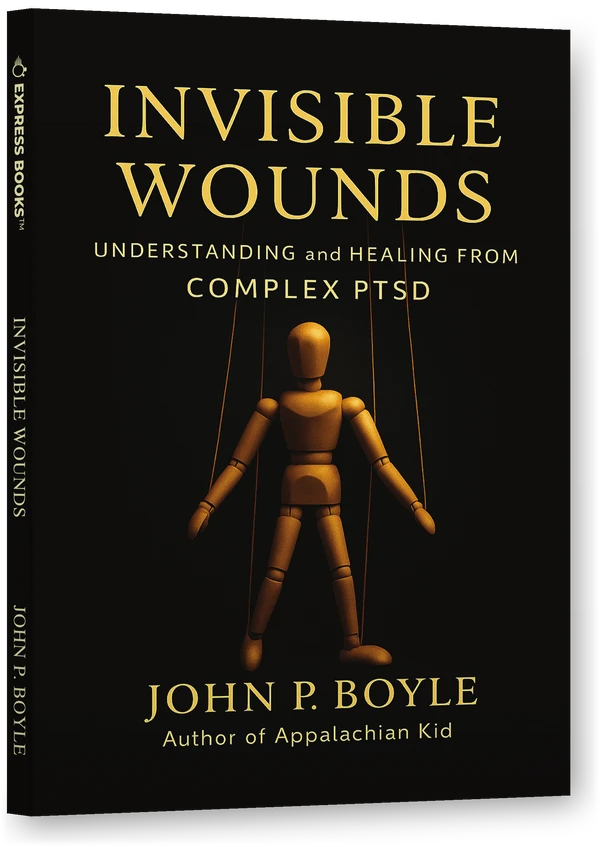
By John P. Boyle
Invisible Wounds
Understanding and Healing from Complex PTSD
For anyone who has asked why they react so strongly or feel unsafe even when they are safe, for survivors of childhood trauma, including men who were taught to push through alone, and for readers who want a faith-friendly account of recovery.
John P. Boyle names his invisible enemy, complex post-traumatic stress disorder, and walks the road to healing through lifelines and hope.
15% off first order + free standard shipping to 223 countries
Afghanistan, Åland Islands, Albania, Algeria, Andorra, Angola, Anguilla, Antigua And Barbuda, Argentina, Armenia, Aruba, Australia, Austria, Azerbaijan, Bahamas, Bahrain, Bangladesh, Barbados, Belgium, Belize, Benin, Bermuda, Bhutan, Bolivia, Bosnia And Herzegowina, Botswana, Brazil, Brunei Darussalam, Bulgaria, Burkina Faso, Burundi, Cambodia, Cameroon, Canada, Cape Verde, Caribbean Netherlands, Cayman Islands, Central African Republic, Chad, Chile, China, Colombia, Comoros, Cook Islands, Costa Rica, Cote D'ivoire, Croatia (Local Name: Hrvatska), Curaçao, Cyprus, Czech Republic, Denmark, Djibouti, Dominica, Dominican Republic, Ecuador, Egypt, El Salvador, Equatorial Guinea, Eritrea, Estonia, Ethiopia, Falkland Islands (Malvinas), Faroe Islands, Fiji, Finland, France, French Guiana, French Polynesia, Gabon, Gambia, Georgia, Germany, Ghana, Gibraltar, Greece, Greenland, Grenada, Guadeloupe, Guam, Guatemala, Guernsey, Guinea, Guinea-Bissau, Guyana, Haiti, Holy See (Vatican City State), Honduras, Hong Kong, Hungary, Iceland, India, Indonesia, Iraq, Ireland, Isle of Man, Israel, Italy, Jamaica, Japan, Jersey, Jordan, Kazakhstan, Kenya, Kiribati, Kuwait, Kyrgyzstan, Lao People's Democratic Republic, Latvia, Lebanon, Lesotho, Liberia, Libyan Arab Jamahiriya, Liechtenstein, Lithuania, Luxembourg, Macao, Macedonia, The Former Yugoslav Republic Of, Madagascar, Malawi, Malaysia, Maldives, Mali, Malta, Martinique, Mauritania, Mauritius, Mayotte, Mexico, Moldova, Republic Of, Monaco, Mongolia, Montenegro, Montserrat, Morocco, Mozambique, Myanmar, Namibia, Nauru, Nepal, Netherlands, New Caledonia, New Zealand, Nicaragua, Niger, Nigeria, Niue, Norway, Oman, Pakistan, Palestinian Territory, Occupied, Panama, Papua New Guinea, Paraguay, Peru, Philippines, Pitcairn, Poland, Portugal, Puerto Rico, Qatar, Republic of Korea, Reunion, Romania, Rwanda, Saint Barthélemy, Saint Kitts And Nevis, Saint Lucia, Saint Martin, Saint Vincent And The Grenadines, Samoa, San Marino, Sao Tome And Principe, Saudi Arabia, Senegal, Serbia, Seychelles, Sierra Leone, Singapore, Sint Maarten, Slovakia (Slovak Republic), Slovenia, Solomon Islands, Somalia, South Africa, Spain, Sri Lanka, St. Helena, St. Pierre And Miquelon, Sudan, Suriname, Svalbard And Jan Mayen Islands, Swaziland, Sweden, Switzerland, Taiwan, Tajikistan, Tanzania, United Republic Of, Thailand, Timor-Leste, Togo, Tokelau, Tonga, Trinidad And Tobago, Tunisia, Turkey, Turkmenistan, Turks And Caicos Islands, Tuvalu, Uganda, Ukraine, United Arab Emirates, United Kingdom, United States, Uruguay, Uzbekistan, Vanuatu, Viet Nam, Virgin Islands (British), Wallis And Futuna Islands, Western Sahara, Yemen, Zambia, Zimbabwe
You are not crazy. You are injured, and healing is possible.
John, you're not crazy, you're injured.
For anyone who has asked why they react so strongly, why they feel unsafe even when they are safe, or why they cannot just get over the past. John P. Boyle lived nearly four decades with Complex PTSD he could not name. Invisible Wounds is the book he needed back then, a four-part walk through what trauma does to the body and brain, and a road toward hope.
What makes this book for readers who want to understand complex PTSD
Invisible Wounds does not diagnose you, and it does not drown you in jargon. John says his goal is “to explain what is happening in a way that feels like you're finally being spoken to, not spoken about.”
Five things set it apart:
A note before you begin: this book describes childhood abuse and its effects. John says he wants “to share my story in a way that doesn't retraumatize you but helps you recognize your own strength.”
- It names the enemy. Part One, “Naming the Invisible Enemy,” opens with the author's own story: sleepless nights, startle responses and the quiet certainty that something was wrong with him, until a trauma-informed therapist gave it a name.
- It explains the body. Part Two, “The Body Keeps the Score,” shows how trauma lives in muscles, stomachs and sleep, and how a child's brain can be wired for “fight, flight, freeze, or fawn” long after the danger has passed.
- It answers the question every survivor asks. Part Three, “The Tangled Puppet Strings,” takes on “Why can't I just get over it?” and a chapter called “Misdiagnosis Roulette,” about the string of labels John collected before the right one.
- It speaks directly to male survivors. A page called “The Untold Story of Male Trauma Survivors” begins, “Men are taught to push through.”
- It treats faith as rescue, not doctrine. Scripture and prayer appear as comfort and companionship, and Part Four, “The Road to Healing,” ends with lifelines and hope.
About the author
Written by
John Boyle
Published by
 Spirit Media Publishing

John Boyle
John P. Boyle grew up in a small town in the mountains of West Virginia. He went on to boarding school and Harvard and built a career as a business leader while living for nearly four decades with Complex PTSD he could not name. Diagnosed by a trauma-informed therapist, he now writes about childhood trauma, male survivors and the role of faith in recovery. He is a husband and father and the author of Appalachian Kid.
Spirit Media Publishing
Spirit Media Publishing is a Christian publishing and marketing company with a vision to reveal our Father's heart to all nations. It offers full-service book creation and publishing in paperback, hardback, digital and audiobook formats, along with children's titles, compact Express Books, website design and SEO, and podcast and video production. We are honored to publish John P. Boyle's story.
What's inside
- A survivor's story told with care, in four parts and eight chapters, with an introduction and an epilogue
- Survivor Insight exercises for naming pain and replacing self-blame with accuracy
- A quick grounding exercise, the 5-4-3-2-1 reset, for moments of panic
- A letter to the author's younger self in the epilogue, Dear Younger Me
- A resources section with a self-assessment that is not a diagnostic test, a Day One Healing Action Plan, guidance for finding a trauma-informed therapist, warning signs in children, organizations that can help, questions to bring to a provider and Scriptures for healing and hope
- A paperback of 130 pages, 6 x 9 inches, with eBook, PDF and audiobook editions
Product details
- Title
- Invisible Wounds
- Paperback ISBN
- 979-8-89307-218-1
- eBook ISBN
- 979-8-89307-219-8
- Subtitle
- Understanding and Healing from Complex PTSD
- Author
- John P. Boyle, author of Appalachian Kid
- Publisher
- Spirit Media Publishing
- Language
- English
- Pages
- 130
- Trim size
- 6 x 9 inches
- Binding
- Paperback (perfect bound), cream paper, black and white interior
- Library of Congress Control Number
- 2026902584
For anyone who has asked why they react so strongly
If a slammed door makes your heart leap, if you tense up before a hard conversation, or if you feel unworthy no matter what you achieve, this book offers language and company. John writes, “My reactions weren't overreactions; they were survival skills that had outlived their usefulness.” It reads like a conversation with someone who has been where you are.
For survivors of childhood trauma, including men who were taught to push through alone
John grew up in a small town in the mountains of West Virginia, with a home that looked normal from the outside. He became an achiever, a funny one, the helpful kid, building what he calls a mask. He writes honestly about hiding symptoms behind success and about drinking and isolation. If you have been told to “man up,” the sentence that follows in the book is worth hearing: “Being a male survivor doesn't make you weak. Speaking about it makes you courageous.”
For readers who want a faith-friendly account of trauma and recovery
God appears here as a gentle Father who meets a worn-out man on his knees, not as a punishing figure. John writes of Psalm 34:18, “The Lord is close to the brokenhearted and saves those who are crushed in spirit,” and of lifelines, the teachers, friends and mentors who stayed. This is a personal and faith-friendly book. It is not medical advice or a treatment guide, and it encourages you to find a trauma-informed professional.
For families, friends, pastors and helpers
If you love someone who carries these wounds, the book shows what helped. Chapter 7, Finding Your Lifelines, honors the people who stayed: a dorm parent at boarding school, teachers, friends and mentors. John writes that lifelines keep you afloat long enough to breathe again. The resources at the back list warning signs in children, organizations that can help and questions to bring to a provider, so a parent, pastor or friend can take a first step too.
Three stories from the book
“You're not crazy, you're injured”
John spends nearly four decades believing his pain means he is defective. He calls the sleepless nights, the startle responses and the headaches stress, anxiety and bad nerves. Then a trauma-informed therapist explains that Complex PTSD comes from chronic, inescapable stress, usually in childhood, “what happens when the people meant to protect you are the ones who cause you pain.” For the first time, the chaos makes sense. He stops asking what is wrong with him and begins asking what happened to him.
The morning his body spoke
At thirty-six, running a fast-growing business and traveling constantly, John wakes with his heart pounding and his chest tight. He ends up in the emergency room convinced he is dying. The physician comes back smiling. “Good news,” he says. “Your heart is perfect. It's probably just stress.” John writes that the physician was right, but not in the way he thought: “It was unresolved trauma that had been simmering for decades.” The chapter becomes an invitation to listen to the body instead of silencing it.
The mirror moment
Years later, volunteering at his hometown high school as a successful businessman, John sits in a small-group discussion when a mistreated teenage boy looks at him and says, “God doesn't love everyone. He plays favorites.” John sees himself in that boy: the same hollow ache and quiet despair. He realizes that his success has not healed him, only distracted him. He writes, “That was the day I stopped running from my past.”
Why this book exists
John says he wrote the book because he does not want you to wander as long as he did. “I don't want you to blame yourself for things that were never your fault. I don't want you to feel alone in symptoms that millions of people experience but rarely talk about.”
He also gives a plain reason for writing about something so painful: “Because pain loses power when it's spoken out loud. Because healing grows when it's shared.” He believes “God carried me through things I didn't understand so that I could turn back and help others,” and that “none of us are meant to heal in isolation.” The book ends with a letter to the boy he once was, and an invitation to write your own.
Questions
What is Invisible Wounds about?
It is John P. Boyle's account of living nearly four decades with Complex PTSD he could not name, and a four-part guide to understanding it and walking the road to healing. The subtitle is Understanding and Healing from Complex PTSD.
What does the book mean by complex PTSD?
In the author's words it is “a disorder of reactions,” and it “is not about what is wrong with you; it is about what happened to you.” He explains that it develops from chronic, inescapable stress, usually in childhood, rather than from one event.
What does the book say about hypervigilance and fight, flight, freeze?
Part Two shows how trauma lives in the body and rewires a child's brain for fight, flight, freeze or fawn. Hypervigilance, startle responses and panic are among the experiences the author describes in his own life.
Is it about childhood trauma and men's mental health?
Yes to both. It follows the effects of a chaotic childhood into adulthood, and it speaks directly to male survivors, who are taught to push through alone.
Does it explain emotional flashbacks and toxic shame?
It does, in Chapter 3. John describes “gray days” that turned out to be emotional flashbacks, and he separates guilt from shame: “Guilt says, 'I did something wrong.' Shame says, 'I am something wrong.'”
Are there exercises for calming the nervous system?
Yes. Survivor Insight exercises help you name pain and replace self-blame with accuracy, and a 5-4-3-2-1 grounding reset helps when the body goes into panic or freeze mode. The resources section adds a five-step plan for day one.
Is Scripture part of the healing?
Scripture and prayer run through the book. Psalm 34:18 carried John through many dark nights, and the resources section lists verses for healing and hope. Faith appears as rescue, not doctrine.
Does it show how to heal from trauma?
It shows where to start. Part Four, The Road to Healing, is about lifelines and hope, and the resources give a five-step Day One Healing Action Plan. They are, in order:
- Name One Truth
- Create One Safe Space
- Tell One Safe Person
- Make One Appointment
- Choose One Daily Regulation Practice
The book is not a treatment guide and points readers to a trauma-informed professional.
Is it a clinical book, and who is it for?
No. The author explains what is happening without diagnosing and without overwhelming; it is a personal and faith-friendly account, not medical advice or a treatment guide. It is for anyone who has asked why they react so strongly, for survivors of childhood trauma, and for readers who want a faith-friendly account of recovery.