
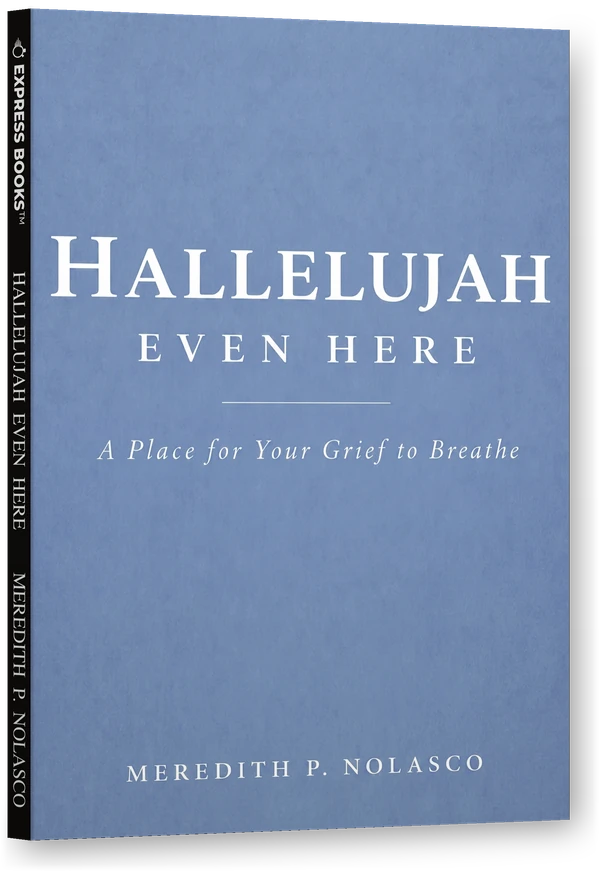
By Meredith P. Nolasco
Hallelujah Even Here
A Place for Your Grief to Breathe
For mothers who have known the loss of a baby, for the fathers who stand beside them, and for anyone who has lost a child or loves someone who has.
A mother's telling of a baby born at twenty-seven weeks who lived twelve days, written as companionship rather than answers.
15% off first order + free standard shipping to 223 countries
Afghanistan, Åland Islands, Albania, Algeria, Andorra, Angola, Anguilla, Antigua And Barbuda, Argentina, Armenia, Aruba, Australia, Austria, Azerbaijan, Bahamas, Bahrain, Bangladesh, Barbados, Belgium, Belize, Benin, Bermuda, Bhutan, Bolivia, Bosnia And Herzegowina, Botswana, Brazil, Brunei Darussalam, Bulgaria, Burkina Faso, Burundi, Cambodia, Cameroon, Canada, Cape Verde, Caribbean Netherlands, Cayman Islands, Central African Republic, Chad, Chile, China, Colombia, Comoros, Cook Islands, Costa Rica, Cote D'ivoire, Croatia (Local Name: Hrvatska), Curaçao, Cyprus, Czech Republic, Denmark, Djibouti, Dominica, Dominican Republic, Ecuador, Egypt, El Salvador, Equatorial Guinea, Eritrea, Estonia, Ethiopia, Falkland Islands (Malvinas), Faroe Islands, Fiji, Finland, France, French Guiana, French Polynesia, Gabon, Gambia, Georgia, Germany, Ghana, Gibraltar, Greece, Greenland, Grenada, Guadeloupe, Guam, Guatemala, Guernsey, Guinea, Guinea-Bissau, Guyana, Haiti, Holy See (Vatican City State), Honduras, Hong Kong, Hungary, Iceland, India, Indonesia, Iraq, Ireland, Isle of Man, Israel, Italy, Jamaica, Japan, Jersey, Jordan, Kazakhstan, Kenya, Kiribati, Kuwait, Kyrgyzstan, Lao People's Democratic Republic, Latvia, Lebanon, Lesotho, Liberia, Libyan Arab Jamahiriya, Liechtenstein, Lithuania, Luxembourg, Macao, Macedonia, The Former Yugoslav Republic Of, Madagascar, Malawi, Malaysia, Maldives, Mali, Malta, Martinique, Mauritania, Mauritius, Mayotte, Mexico, Moldova, Republic Of, Monaco, Mongolia, Montenegro, Montserrat, Morocco, Mozambique, Myanmar, Namibia, Nauru, Nepal, Netherlands, New Caledonia, New Zealand, Nicaragua, Niger, Nigeria, Niue, Norway, Oman, Pakistan, Palestinian Territory, Occupied, Panama, Papua New Guinea, Paraguay, Peru, Philippines, Pitcairn, Poland, Portugal, Puerto Rico, Qatar, Republic of Korea, Reunion, Romania, Rwanda, Saint Barthélemy, Saint Kitts And Nevis, Saint Lucia, Saint Martin, Saint Vincent And The Grenadines, Samoa, San Marino, Sao Tome And Principe, Saudi Arabia, Senegal, Serbia, Seychelles, Sierra Leone, Singapore, Sint Maarten, Slovakia (Slovak Republic), Slovenia, Solomon Islands, Somalia, South Africa, Spain, Sri Lanka, St. Helena, St. Pierre And Miquelon, Sudan, Suriname, Svalbard And Jan Mayen Islands, Swaziland, Sweden, Switzerland, Taiwan, Tajikistan, Tanzania, United Republic Of, Thailand, Timor-Leste, Togo, Tokelau, Tonga, Trinidad And Tobago, Tunisia, Turkey, Turkmenistan, Turks And Caicos Islands, Tuvalu, Uganda, Ukraine, United Arab Emirates, United Kingdom, United States, Uruguay, Uzbekistan, Vanuatu, Viet Nam, Virgin Islands (British), Wallis And Futuna Islands, Western Sahara, Yemen, Zambia, Zimbabwe
A mother tells the story of her son, who lived twelve days, and finds a place for her grief to breathe.
I write for the mothers who have known this kind of loss, who are searching for language for a pain that feels unspeakable.
For mothers who have known the loss of a baby and are searching for language for the pain, for the fathers who stand beside them, and for anyone who has lost a child or loves someone who has. Meredith P. Nolasco writes in twenty-six short chapters, with dated entries addressed to her son, about a birth at twenty-seven weeks, the NICU, the night he died and the long months after. It offers companionship rather than answers. A note on subjects: this is a memoir of the death of a baby. It describes an emergency birth, intensive care, the moments of the baby's death, cremation, and the physical and emotional weight of grief, told honestly and without graphic detail. It is a mother's telling, not medical, counseling or mental health advice. If grief or trauma is overwhelming you, please contact a physician or licensed professional, and if you are in crisis or thinking about harming yourself, contact your local emergency services or a crisis line right away.
What makes this book for people carrying the loss of a baby
This is the story of a baby boy born at twenty-seven weeks, weighing two pounds, six ounces. His nursery was finished and his name was chosen. Then an ordinary Sunday came apart in minutes. The author does not hand the reader a method. She tells what happened, what she asked God, and what she learned about holding sorrow and love in the same hands.
Five things set it apart:
- It is a telling, not a guide. The Introduction says so in plain words: "This is not a guide on how to grieve."
- It stays close to one family and one baby. The chapters follow the emergency, the NICU days, the one hour of holding him on Day 12, the night he died, and the months after.
- It speaks to fathers and to the people around a grieving family. A chapter on what people say, a chapter on a marriage under strain and a chapter on mothering a toddler while mourning an infant sit beside the hospital chapters.
- It brings the hardest question to God and does not tidy the answer. One chapter is titled Why a Child?, another Wrestling, another A Stubborn Hope.
- Hope is present but not loud. The author writes that hope here "exists right alongside the pain" and is "sometimes steady, sometimes barely there, but real."
About the author
Written by
Meredith P. Nolasco
Published by
 Spirit Media Publishing

Meredith P. Nolasco
Meredith P. Nolasco is a wife, a mother and a coach who, with her husband, walks with people toward better health, helping them plan, prepare and build steady rhythms. Her faith in Jesus is personal, something she chose beyond the foundation she was raised in. In January 2026 her second son was born at twenty-seven weeks and lived for twelve days in the NICU. During those days she began writing to him, and those words grew into this book.
Spirit Media Publishing
Spirit Media Publishing is a Christian publishing and marketing company with a vision to reveal our Father's heart to all nations. It offers full-service book creation and publishing in paperback, hardback, digital and audiobook formats, along with children's titles, compact Express Books, website design and SEO, and podcast and video production. We are honored to publish this mother's telling of her son's life.
What's inside
- Twenty-six short chapters, from the Introduction to a closing chapter titled I'll Always Be Your Mommy
- Dated entries written to her son, from January 8 to April 7, 2026
- Chapters on shock, on what people say, on grief inside a marriage, on mothering a toddler through loss, and on a question that used to be simple: Do you have children?
- Scripture quoted in the NIV and the NKJV
- A portrait of her son on the first pages, with the dates of his life: January 4 to January 16, 2026
- A paperback of 110 pages, also published as an eBook and a PDF edition
Product details
- Title
- Hallelujah Even Here
- Paperback ISBN
- 979-8-89307-276-1
- eBook ISBN
- 979-8-89307-277-8
- Subtitle
- A Place for Your Grief to Breathe
- Author
- Meredith P. Nolasco
- Publisher
- Spirit Media Publishing
- Language
- English
- Pages
- 110 (paperback)
- Trim size
- 5.5 x 8.5 inches
- Binding
- Paperback (perfect bound, matte laminate), black and white interior on creme paper
- Library of Congress Control Number
- 2026912421
For mothers who have known this kind of loss
If you are searching for language, this book may lend you some. The author describes the silent morning after, the milk that came in with no baby to feed, and the way she woke each day and thought of the same Friday. She writes that she did not soften it: "So I don't soften it." She also writes that she no longer needs to make people comfortable in her grief.
For fathers and the people who love them
The author writes about her husband with respect. Their grief is the same loss from different places. She names it in a line that returns through the chapter: "Same loss. Different heart journey." The book does not instruct a father. It shows two people choosing, again and again, to stay beside each other.
For friends, family and caregivers who want to know what helps
A chapter called I Can't Imagine turns a familiar sentence around, and a chapter called How Are You Doing? asks what that question costs. She writes that people who choose to sit in the valley with her are doing "holy work without knowing it." A reader who wants to sit with someone grieving will find what that can look like.
For anyone wrestling with why a child
The book gives space to anger, numbness and the question itself. It does not say that a child's death makes sense. It says that Scripture rarely explains and often shows. The author asks her questions of God in the open and also writes: "There were moments I felt undeniably held."
Three moments from the book
The Sunday it came apart
Chapter 2 begins with a normal Sunday: church in the morning, waffles after, a soccer ball in the backyard. Then pain, then the floor, then sirens. At twenty-seven weeks, her water broke, and she writes that "What had been a normal Sunday unraveled in minutes." A nurse held the baby in until the surgical team could take her in for an emergency C-section. She whispered prayers, asking God to go where she could not. Then, she writes, "He was here. Tiny. Fighting. Alive."
The hour on Day 12
Chapter 4 begins with a gift. The lead physician asked whether she would like to hold him, and for the first time she did, with him resting on her chest. "I felt my whole body exhale," she writes. She went home planning to spend the whole next day with him. She had no way to know, she writes, that "it would be the only time I would ever hold him full of life." That evening came three calls from the hospital. Chapter 4 ends in the NICU, in her arms, with the monitors fading and her son gone.
Two strands of hair
In Chapter 7, the author looks at a photograph and thinks that she should have kept a small piece of his hair. Days later, sitting in his room with his hospital blanket in her lap, she peels back a fold and finds "two small pieces of his hair, intertwined, caught in the fabric." She does not claim to understand why a child died. She does write that "God knew I would need that moment," and that He "left a couple for his mom." It is one of the book's smallest and most tender chapters.
Why this book exists
The author asks the question herself in the first paragraph and answers it plainly: "Because I have to." She writes of "A sacred urgency that settles in my chest and does not lift until I let the words out."
She says who the book is for and what it will not do. "This book is simply a telling," she writes, "Of our baby who lived." And her last sentence to the reader is the title: "Hallelujah even here."
Questions
What is Hallelujah Even Here about?
It is Meredith P. Nolasco's honest telling of her son, born at twenty-seven weeks, who lived twelve days in the NICU, and of grief, faith and the hardest question: why a child? It is told in twenty-six short chapters with dated entries written to her son.
Is it a book about pregnancy and infant loss?
Yes, in the sense that it follows one family through the birth and death of a baby who lived twelve days. The phrase pregnancy and infant loss does not appear in the interior, and the book does not claim to cover the subject broadly. The author also mentions an earlier miscarriage in one line. It is one mother's story, not a reference book.
Is it about a premature baby?
Yes. The baby was born at twenty-seven weeks after a sudden emergency, spent twelve days in the NICU and died there. The word premature does not appear in the book. It speaks of twenty-seven weeks, the NICU, monitors and a two pound, six ounce baby.
Is it a guide on how to grieve?
No. The Introduction says it is "not a roadmap, or a list of steps." It offers companionship and does not tie itself up neatly: "It's not a story that ties itself up neatly in the end."
What does the book say about surrender to God?
She describes surrender as "a posture. A choice," not giving up but "loosening my grip." Looking back, she would tell her earlier self to loosen her grip and to cling more to God's sovereignty than to statistics. She also writes that surrender "doesn't feel like peace" at first.
Does it speak to healing after loss?
It does not promise a cure or a timeline. It describes a slow, uneven mercy: shock that shelters, sorrow that arrives later, joy and grief that "stand side by side," and a purpose that grows quieter. The author writes that the hope she found "doesn't erase sorrow or rush healing."
Is it for grieving parents, including fathers?
Yes. The Introduction names mothers and fathers, and a chapter is given to what grief looks like inside a marriage. It is also written for anyone who has lost a child or loves someone who has.
Does the book talk about her baby in heaven?
Yes, simply and without speculation. She writes that while her son knew the voice and touch of his mommy, he also knows that of his Heavenly Father. Her closing lines are "Our baby lived. He is with Jesus. And I am still his mommy."