
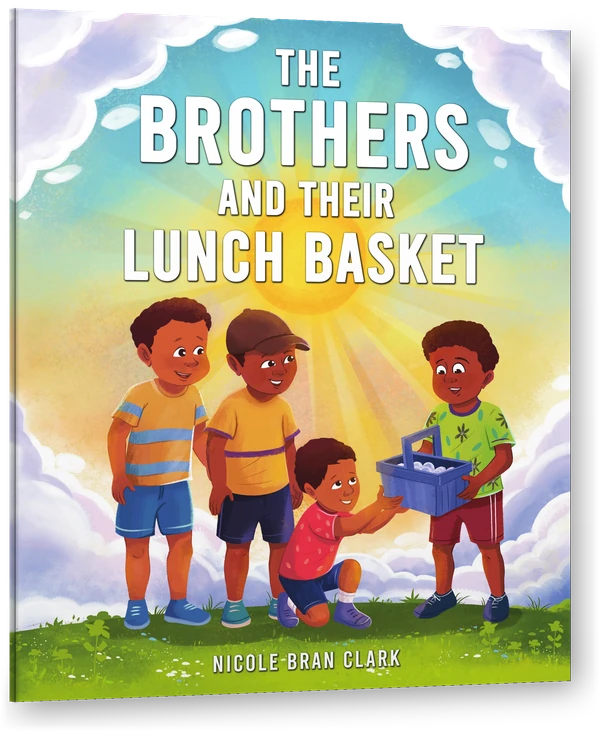
By Nicole Bran Clark · Ages 4–8
The Brothers and Their Lunch Basket
For early readers and read-aloud time with parents and grandparents, for Sunday school lessons and children's ministry, and for any child learning that a small gift offered with love can bless many.
Four brothers share their small lunch of five loaves and two fish and watch Jesus feed a crowd too big to count in this warm retelling for young readers.
15% off first order + free standard shipping to 223 countries
Afghanistan, Åland Islands, Albania, Algeria, Andorra, Angola, Anguilla, Antigua And Barbuda, Argentina, Armenia, Aruba, Australia, Austria, Azerbaijan, Bahamas, Bahrain, Bangladesh, Barbados, Belgium, Belize, Benin, Bermuda, Bhutan, Bolivia, Bosnia And Herzegowina, Botswana, Brazil, Brunei Darussalam, Bulgaria, Burkina Faso, Burundi, Cambodia, Cameroon, Canada, Cape Verde, Caribbean Netherlands, Cayman Islands, Central African Republic, Chad, Chile, China, Colombia, Comoros, Cook Islands, Costa Rica, Cote D'ivoire, Croatia (Local Name: Hrvatska), Curaçao, Cyprus, Czech Republic, Denmark, Djibouti, Dominica, Dominican Republic, Ecuador, Egypt, El Salvador, Equatorial Guinea, Eritrea, Estonia, Ethiopia, Falkland Islands (Malvinas), Faroe Islands, Fiji, Finland, France, French Guiana, French Polynesia, Gabon, Gambia, Georgia, Germany, Ghana, Gibraltar, Greece, Greenland, Grenada, Guadeloupe, Guam, Guatemala, Guernsey, Guinea, Guinea-Bissau, Guyana, Haiti, Holy See (Vatican City State), Honduras, Hong Kong, Hungary, Iceland, India, Indonesia, Iraq, Ireland, Isle of Man, Israel, Italy, Jamaica, Japan, Jersey, Jordan, Kazakhstan, Kenya, Kiribati, Kuwait, Kyrgyzstan, Lao People's Democratic Republic, Latvia, Lebanon, Lesotho, Liberia, Libyan Arab Jamahiriya, Liechtenstein, Lithuania, Luxembourg, Macao, Macedonia, The Former Yugoslav Republic Of, Madagascar, Malawi, Malaysia, Maldives, Mali, Malta, Martinique, Mauritania, Mauritius, Mayotte, Mexico, Moldova, Republic Of, Monaco, Mongolia, Montenegro, Montserrat, Morocco, Mozambique, Myanmar, Namibia, Nauru, Nepal, Netherlands, New Caledonia, New Zealand, Nicaragua, Niger, Nigeria, Niue, Norway, Oman, Pakistan, Palestinian Territory, Occupied, Panama, Papua New Guinea, Paraguay, Peru, Philippines, Pitcairn, Poland, Portugal, Puerto Rico, Qatar, Republic of Korea, Reunion, Romania, Rwanda, Saint Barthélemy, Saint Kitts And Nevis, Saint Lucia, Saint Martin, Saint Vincent And The Grenadines, Samoa, San Marino, Sao Tome And Principe, Saudi Arabia, Senegal, Serbia, Seychelles, Sierra Leone, Singapore, Sint Maarten, Slovakia (Slovak Republic), Slovenia, Solomon Islands, Somalia, South Africa, Spain, Sri Lanka, St. Helena, St. Pierre And Miquelon, Sudan, Suriname, Svalbard And Jan Mayen Islands, Swaziland, Sweden, Switzerland, Taiwan, Tajikistan, Tanzania, United Republic Of, Thailand, Timor-Leste, Togo, Tokelau, Tonga, Trinidad And Tobago, Tunisia, Turkey, Turkmenistan, Turks And Caicos Islands, Tuvalu, Uganda, Ukraine, United Arab Emirates, United Kingdom, United States, Uruguay, Uzbekistan, Vanuatu, Viet Nam, Virgin Islands (British), Wallis And Futuna Islands, Western Sahara, Yemen, Zambia, Zimbabwe
A small lunch. A crowd too big to count. A miracle four brothers saw up close.
But David, remember how Ima always says that when we share what we have, even if it's just a little, God can use it to bless many?
For parents, grandparents and teachers who want a warm way to tell a child the story of the loaves and fishes. Four brothers stop on their way to school, find a hillside full of hungry people, and Asher asks a question that changes the day: what if we gave them our lunch?
What makes this book for children who are learning that a small gift can matter
A picture-book retelling of Jesus feeding the five thousand, seen through the eyes of children. It begins at a kitchen table with pancakes and ends back at that same home, with a mother who has one more thing to say about sharing.
Five things set it apart:
- It is told through four brothers. Asher is full of questions, Elijah rushes in tying his shoes, Samuel is the careful one who checks the weather, and David hums quietly and pulls out chairs for everyone. Children often find themselves in one of them.
- It keeps the Bible event clear. The author's note says the miracle is drawn from the Bible while the characters and some events are fictional, and it reminds readers that “the Bible tells the true account.” The note to parents points to John 6:1-14 so the two can be read side by side.
- It puts a child at the center of the miracle. The basket holds five loaves of bread and two fish, and it is Asher, not a grown-up, who walks over and offers it.
- It is made for reading aloud. There are 40 pages, 8 x 10 inches, in color, with short scenes of two or three lines that are easy to pause on and talk about.
- It gives you the questions to ask. A closing note for parents, teachers and ministry leaders suggests ways to read with expression and to talk afterward, including “What would you have done if you were Asher?”
About the author
Written by
Nicole Bran Clark
Published by
 Spirit Media Publishing

Nicole Bran Clark
Nicole Bran Clark wrote The Brothers and Their Lunch Basket as a creative retelling of the miracle of Jesus feeding the 5,000, with the aim of helping young readers engage with the story in a fun and imaginative way. In her note at the front of the book she explains that the characters and some events are fictional and that the Bible tells the true account. Her book comes with a note for the adults who read it with children.
Spirit Media Publishing
Spirit Media Publishing is a Christian publishing and marketing company with a vision to reveal our Father's heart to all nations. It offers full-service book creation and publishing in paperback, hardback, digital and audiobook formats, along with children's titles, compact Express Books, website design and SEO, and podcast and video production. We are honored to publish Nicole Bran Clark's story for young readers.
What's inside
- A retelling of Jesus feeding the five thousand, told through four brothers and their mother, Ima
- Four brothers with four personalities: Asher the curious one, Elijah the adventurous one, Samuel the careful one and David the peacemaker
- A Note from the Author at the front, and a Note to Parents, Teachers, and Ministry Leaders at the back
- Three read-aloud questions and a pointer to John 6:1-14 for reading the Bible account together
- Four short affirmations of a child's God-given traits, one for each brother
- A paperback of 40 pages, 8 x 10 inches, in full color, also published as an eBook and a PDF edition
Product details
- Title
- The Brothers and Their Lunch Basket
- Paperback ISBN
- 979-8-89307-186-3
- eBook ISBN
- 979-8-89307-173-3
- Author
- Nicole Bran Clark
- Publisher
- Spirit Media Publishing
- Language
- English
- Pages
- 40
- Trim size
- 8 x 10 inches
- Binding
- Paperback (perfect bound), color interior
- Reading level
- ages 4 to 8, early readers and read-aloud
- Library of Congress Control Number
- 2026902881
For parents and grandparents who read aloud
If you love bedtime stories with a point worth talking about, this one gives you plenty to stop for. The scenes are short, the dialogue is lively, and the brothers are easy to voice. Ima's line about sharing comes back twice, once from Asher and once at the very end, so a child can hear it, see it happen and say it back.
For Sunday school teachers and children's ministry leaders
A feeding-of-the-five-thousand lesson needs a way in for the youngest children, and this gives you one. The Note to Parents, Teachers, and Ministry Leaders lists values to explore, namely generosity, obedience, curiosity and faith, and it suggests reading John 6:1-14 together afterward to talk about how Jesus multiplied the loaves and fish and what that shows about faith and compassion.
For kids who ask big questions
Asher is the boy who asks why the sky turns orange before sunrise, and he is also the boy who asks what would happen if they gave away their lunch. The other brothers doubt him, grumble about being hungry and wonder how anything could be enough. The book lets those feelings be real, and then it lets the miracle happen.
For families with children who are all different
The four brothers are four kinds of children: the curious one, the adventurous one, the careful one and the peacemaker. The closing note turns that into a way to affirm your own child, with four short lines to say out loud: “Curiosity is a gift.” “Adventurous hearts can lead others.” “Cautious thinkers help keep everyone grounded.” “Peacemakers reflect the heart of Jesus.” It also suggests asking which brother your child relates to most, and why.
Three stories from the book
Too many people to count
On the way to school, the brothers hear a commotion, and Elijah decides they should look. “Oh, who cares if we're late!” he says, running toward the crowd. They find a huge gathering of men, women and children talking, laughing and playing, “and even babies were there!” David notices a smaller group of men standing aside with worried faces. The brothers creep up behind a tree to listen, and hear a man ask Philip where they are to buy bread so these people can eat. Philip's answer is honest: there are too many people, and they do not have enough money.
What if we gave them our lunch?
Asher looks at the basket and thinks of all those hungry faces. “I know it's not much—just five loaves of bread and two fish—but I can't stop thinking about all those hungry faces. Maybe it could help.” David pushes back: “Then we will be hungry and without any food for our lunch.” Asher reminds him what Ima always says, and David gives in: “You're right Asher, they do need our help. We'll be okay.” Asher walks up to the man with brown eyes and says, “It's not much, but... you can have our lunch.”
The longest day of school
After the crowd has been fed, the brothers realize they are late, and school is hard. Asher stares at his lunch cubby, wondering if it still holds a miracle. David doodles loaves and fish all over his worksheet. Elijah fiddles with his pencil during read-aloud time. Samuel raises his hand to answer a math question and forgets what he was going to say. When they get home, Ima asks only, “Did you boys remember to be kind today?” and David blurts out, “We shared our lunch,” and then, “And somehow... it fed everyone!”
Why this book exists
The closing note says the book “was written to help children imagine themselves as part of one of Jesus' most famous miracles—the feeding of the five thousand.” It describes the four brothers as having “unique personalities” so that children can explore “important values like generosity, obedience, curiosity, and faith.”
The note offers the story as “a springboard for deeper conversations about how God can use even small offerings in big ways when we choose to share and trust Him.” Its final hope is that children will believe “that God can use them—just as they are—to make a difference in the world.”
Questions
What is The Brothers and Their Lunch Basket about?
It is a retelling of Jesus feeding a crowd with five loaves and two fish, told through four brothers, one of whom, Asher, offers the family's lunch basket.
Is this the loaves and fishes story?
Yes. The basket holds five loaves of bread and two fish, Asher gives it to Philip, and Jesus feeds the crowd. The brothers and their mother are story characters; the miracle is the Bible event.
What does the book teach children about sharing?
Asher remembers what his mother says: when we share what we have, even if it is just a little, God can use it to bless many. The book is about sharing and trusting God with something small.
What ages is it for?
It is made for early readers and read-aloud, ages 4 to 8. It is 40 pages, 8 x 10 inches, in color.
Can it be used in Sunday school or children's ministry?
Yes. It suits Sunday school lessons and children's ministry, and it is also suited to read-aloud time with parents and grandparents.
Is it one of the Bible stories for kids that works at bedtime?
It is a Bible story for kids, a retelling of the feeding of the five thousand from John 6:1-14. The book does not mention bedtime, but its scenes are short, its dialogue is lively and its closing note recommends reading aloud with expression, so it suits a quiet read before sleep as well as a classroom.
Are the brothers in the Bible?
No. The author's note says the characters and some events are fictional and that the Bible tells the true account. The feeding of the five thousand is found in John 6:1-14, and the book's closing note suggests reading it together.
Does it include questions to talk about afterward?
Yes. The closing note suggests pausing to ask three questions. They are, in order:
- “What would you have done if you were Asher?”
- “Have you ever shared something and watched God bless it?”
- “Which brother do you relate to most and why?” It also lists ways to affirm a child's God-given traits
Is it a read-aloud picture book?
Yes. It has short scenes, lively dialogue and full-color pages, and the closing note recommends reading aloud with expression to help young listeners engage with the story.